
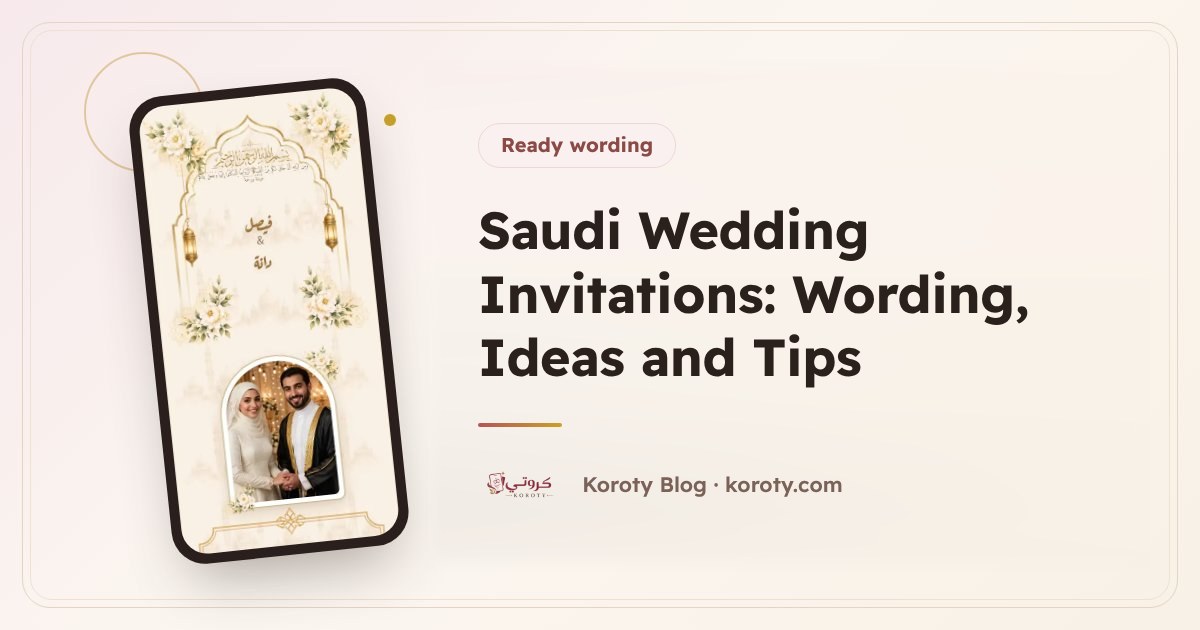
A Saudi wedding invitation is usually marked by formal, refined wording. It is most often issued in the name of the couple's fathers or the two families, and gives the groom's and bride's names, the date and the hall. A digital invitation keeps that character and adds what a wedding needs today: sending on WhatsApp in each guest's name, an RSVP with a set number of accompanying guests, and an entry ticket with a QR code where needed.
What sets wedding invitations in Saudi Arabia apart? #
Details differ from one family and one region to another, but there are familiar general features that recur at many weddings:
- The milka before the wedding: the wedding party is usually preceded by the marriage contract, called the "milka", which may have its own invitation for a smaller circle. For wording, read nikah invitation wording.
- An invitation in the name of the fathers or the two families: the invitation often opens with the name of the groom's father, or both fathers together, then names the couple.
- A men's section and a women's section: it is common for the celebration to be held in two separate sections, sometimes with a different time or place for each.
- Formal, refined language: phrases such as "is honoured to invite you", "God willing" and "your presence will honour us" are a genuine part of the form.
- Entry cards: at some weddings an entry card is requested at the door, especially in the women's section, to manage numbers and privacy.
How do you write a wedding invitation in the Saudi style? #
The usual form follows this order:
- An opening: the Basmala, a verse or a short dua.
- The host: the father's or the family's name, with his title if any.
- The invitation: "is honoured to invite you to the wedding of his son ...".
- The couple: the groom's name, then "to the daughter of" with the bride's father's name. Some families give the bride's name and some don't.
- The date and place: the day, the Hijri or Gregorian date or both, and the hall.
- The close: "Your presence will honour and delight us", or similar.
Ready-made wording for Saudi wedding invitations #
Adapt the names and dates to suit you.
1. From the groom's father (the classic form)
In the name of Allah, the Most Gracious, the Most Merciful. Mr [name] bin [name] Al-[family] is honoured to invite you to the wedding of his son Abdullah to the daughter of Sheikh [name] bin [name] Al-[family], God willing, on Thursday evening, 20/5/1448 AH, at ... Hall in the city of ... Your presence will honour and delight us.
2. From both fathers together
Mr [name] bin [name] Al-[family] and Mr [name] bin [name] Al-[family] are honoured to invite you to the wedding of their children Abdullah and Noura, God willing, on Thursday evening ... at ... Hall. We would be delighted to have you share our joy.
3. An invitation for the women's section
Umm Abdullah and Umm Noura are honoured to invite you to the wedding of Abdullah and Noura, God willing, on Thursday evening ... at ... Hall, women's section. Your presence will add to our joy.
4. With a verse in the opening
"And of His signs is that He created for you spouses from among yourselves, that you may find tranquillity in them." (Ar-Rum 30:21) The Al-[family] family is honoured to invite you to the wedding of their son Faisal to the daughter of the Al-[family] family, God willing, on the evening of ... at ... Hall. Your presence will honour us.
5. A short version for a WhatsApp message
Assalamu alaikum wa rahmatullah. Abdullah's father is honoured to invite you to his son's wedding on Thursday evening, 20/5/1448 AH. The details, the venue location and the RSVP are in the invitation: (invitation link)
6. Stating the number kindly
We would be delighted to have you at the wedding of Abdullah and Noura. Kindly confirm your attendance and the number of guests accompanying you through the invitation. Please note the invitation is for two people. Thank you for your understanding.
For more refined wording and the etiquette of writing it, read elegant wedding invitation wording.
Tips for sending the invitation on WhatsApp #
WhatsApp is the most direct way to deliver the invitation, but how you send it makes the difference:
- Send each guest their personal link: when the guest opens it they see their name on the envelope, and feel the invitation is addressed to them personally and isn't a mass message.
- Open the message with salaam and the name: the first line is what shows in the notification, so make it a proper greeting.
- Avoid large groups: individual sending suits the occasion better and protects guests' privacy.
- Don't forget the elders: a phone call alongside the message for senior members of the family is a courtesy that is appreciated.
On Koroty you press "Send" next to the guest's name and WhatsApp opens with the message ready with their name and link, and "Send to next" moves you to the next guest who hasn't received the invitation. The message text can be edited, so you write it in the formal style that suits you. Because the invitation is usually in the fathers' names, the "family link" is useful: the couple send it to their parents so they add their own guests. Guests can also be sorted into groups such as "Groom's family" and "Bride's family".
RSVP and setting the number of accompanying guests #
One of families' main concerns is knowing the real headcount, especially when the hall has a set capacity. In a digital invitation the guest taps "I'll attend" or "I can't make it" and chooses the number of people within a limit you set, either for the whole invitation or per guest. You can, for example, allow one family five people and a friend two.
Replies appear in your dashboard straight away with clear numbers: how many are attending, how many declined and how many haven't replied yet. The "Remind" button sends a reminder to those who opened the invitation but didn't reply. Details are in wedding RSVP: how to know your guest count.
Entry tickets with a QR code #
If your wedding uses entry cards, a digital ticket is a practical alternative to a printed one. On Koroty you can switch on entry tickets with a QR code for every guest who confirmed, with an optional table number, and the organiser scans them at the door with a phone camera. Read more in QR codes in wedding invitations.
Frequently asked questions #
Does a digital invitation suit formal Saudi weddings? #
Yes, because you write the text however you wish, so you keep the customary formal wording in the names of the fathers and the two families. And you choose a design worthy of the occasion.
Should I send one invitation for men and women? #
It depends on the wedding. If the time and hall are the same, one invitation is enough with a note for guests about each section's entrance. If they differ, it is clearer for each section to have its own invitation.
How do I prevent more people coming than were invited? #
Set the number allowed per guest in the RSVP, mention it kindly in the invitation text, and switch on QR entry tickets if you want to manage entry at the door.
Does the invitation work for the milka too? #
Yes, the invitation suits a milka or nikah just as it suits a wedding, and you write the text however you wish.
Traditions across the Arab world #
For the zaffa, dabke, jaha and how customs differ from the Gulf to the Levant and North Africa, see Arab wedding traditions explained.
The bottom line #
A beautiful Saudi invitation keeps the formal, refined wording and makes use of modern tools: a link in each guest's name, an RSVP with a set number, and an entry ticket where needed. You can design your invitation on Koroty and preview it for free before sending it to your guests.