For a multicultural wedding, word the invitation so both families see themselves in it: name them with equal weight, mention customs in plain language, and translate meaning rather than word for word. A short explanation of each event helps guests who are new to a tradition. Below are 20 samples you can adapt.
This guide is about the words. If your families read different languages and you want each side to get the invitation in theirs, see Arabic and English wedding invitations, which covers how to set up two invitations for one wedding. Here I focus on what to say, whatever language you choose.
Which family's name should come first? #
There is no universal rule, so choose a method that feels fair and stick to it:
- Alphabetical order avoids any suggestion of ranking.
- Bride's family first follows many Western traditions.
- The family hosting the first event goes first for that event, and the other leads for the next one.
- Two separate lines of equal size give both families the same visual weight.
If the two families use different naming customs, such as a family name that comes first or a father's name used as a middle name, write each person the way their family would want to see it. Ask them.
Mr. and Mrs. Samir Haddad and Mr. and Mrs. Ravi Patel request the pleasure of your company at the wedding of their children, Sara and Dev.
Together with their families, Sara Haddad and Dev Patel invite you to celebrate their marriage.
Should you translate the invitation or adapt it? #
Adapt. A word-for-word translation can sound stiff or even change the meaning. Ask a fluent speaker from each family to read their version, and agree on a few rules:
- The facts (date, time, venue, dress code) must be identical.
- The tone (formal or warm) should match.
- Names need one agreed spelling in each script.
- Phrases like "request the honor of your presence" may not exist in the other language. Use the closest natural phrase.
Since a Koroty invitation is currently in one language, a family that reads another language receives its own invitation. See the guide above for the setup.
Which customs should the invitation mention? #
Mention only what guests need in order to attend and dress appropriately. A line of explanation is kinder than silence.
- The events. Name each event and explain it briefly.
- Time and place for each. Different events may be on different days.
- Dress. If a ceremony expects covered shoulders, specific colors or traditional dress, say so.
- Food. If you serve halal, vegetarian or other meals, say it.
- What guests can expect. A processional, a long ceremony, a dance or a ritual they may not know.
Friday evening: the sangeet, a night of music and dance with both families. Saturday: the wedding ceremony, followed by dinner. Sunday: a farewell brunch.
Saturday afternoon: the katb al-kitab, the signing of the marriage contract, with close family. All guests are warmly welcome at the reception that evening.
Our ceremony will include a Hindu ritual walk around the fire, led by a priest. It will take about an hour, and a program will explain each step.
Dinner will be halal, with vegetarian dishes available. Alcohol will not be served.
For events in particular traditions, see Muslim wedding invitations, walima invitation wording and nikah and katb al-kitab invitation wording.
How do you word religious lines respectfully? #
Religious lines are optional, and each family decides. Some common choices:
- Place a short blessing at the top, in the original language with a translation in the same line or below it.
- Use a neutral line such as "with the blessings of our families" if the families follow different faiths.
- Skip it and let the ceremony speak for itself.
In the name of God, the Most Gracious, the Most Merciful. (Bismillah ir-Rahman ir-Rahim.)
With the blessings of God and of our families.
With the blessings of our parents and grandparents, and in the presence of God, we invite you to our wedding.
Shri Ganeshaya Namah. With the blessings of Lord Ganesha, we invite you to the wedding of Priya and Daniel.
Two cautions. Do not mix religious phrases in a way that might offend either family, and ask a respected elder or officiant from each side to read the text. If the wedding is interfaith, a neutral line with religious wording left for the ceremony itself is the safest choice.
What are some mixed-culture wording samples? #
Two families, two languages, one celebration. Together with their families, Sara and Dev invite you to their wedding on Saturday, June 12, 2027, at 5:00 PM.
Sara and Dev are blending the traditions they love. Their wedding will include elements from both families, and we will explain each one as it happens.
The ceremony will be held in English and Arabic. A printed program will help you follow along.
Our families are different in many ways, and we are grateful for it. We hope you will join us to celebrate our marriage.
Con mucho cariño, Camila and Jack invite you to their wedding. With much love, the families of Ruiz and Miller.
Isabel and Giovanni invite you to a wedding with Spanish and Italian roots. Expect long meals, loud music and plenty of dancing.
Please come dressed in your own tradition, whatever feels festive and respectful, and we will be delighted to see it.
Our families celebrate in different ways. You are welcome to join any or all of the events listed below.
Use Spanish, Italian, Arabic or Hindi words you know are right for your family, and keep the English clear for guests who don't read them. If you are unsure, ask a relative to check.
How do you explain traditions to guests who don't know them? #
Add a short "What to expect" in the notes section of the invitation. Two or three plain lines per event are enough.
What to expect: The ceremony lasts about an hour. Guests sit on both sides. After the ceremony, the couple will greet everyone, and dinner begins at 7:00 PM.
A note on dress: Many guests will wear traditional clothing. You are welcome to wear a suit or a dress, as long as shoulders and knees are covered.
How does this work on Koroty? #
On Koroty, put the event names and "What to expect" lines into the schedule and the notes section, and add each family to the invitation in their language, since each invitation has its own guest list. Designing is free, and the permanent link is one payment per invitation; see the pricing page.
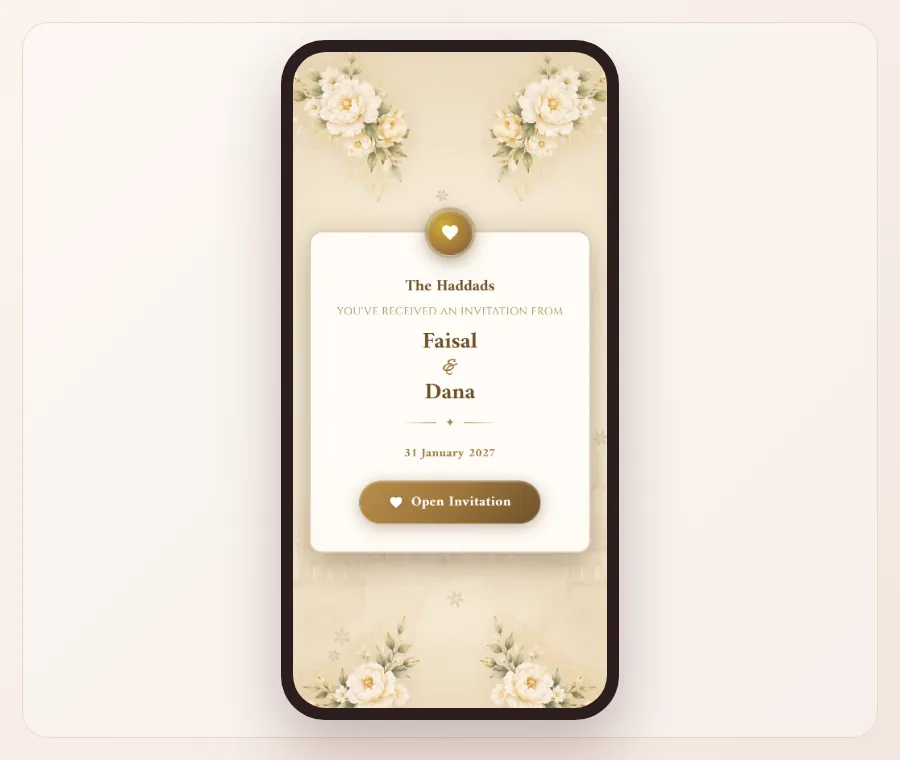
Saraya Gold takes an Andalusian style, with suspended golden lanterns and arabesque, that sits comfortably between cultures. Design yours free and compare how the same wording looks in different designs.
Frequently asked questions #
Do we need to explain every tradition? #
No. Explain what guests need to attend and dress well, and offer more in a program or on the day.
What if one family is more traditional? #
Talk it through early, and respect both. A neutral host line and clear event names usually keep everyone comfortable.
Can we use two languages on the same card? #
On paper, yes. On Koroty, each invitation is currently in one language, so you make one per language.
Should religious text be translated? #
If you include it, adding a short translation helps guests who don't read the original. Ask a knowledgeable person to check the translation.
How do we ask guests to wear traditional dress? #
Invite, don't require. "Traditional dress is welcome" is kinder than "traditional dress required."
The bottom line #
Give both families equal weight, explain the customs in plain words, and ask someone from each side to read the text before you send it. Design yours free, or read the digital wedding invitations guide.