
To address a wedding invitation, write each guest's name the way they use it: title and full name for formal paper cards, such as "Mr. and Mrs. Daniel Reyes," and a friendly form for casual or digital ones, such as "Aunt Rosa." Use titles like Dr. when they apply, list everyone who is invited, and when in doubt, ask the guest or a relative how they prefer to be addressed.
Addressing is a small detail that guests notice. It tells them exactly who is invited and shows you took care. This guide covers the common cases, gives a table of examples, and explains the digital version, where the name you type appears on the guest's envelope.
What do Mr., Mrs., Ms. and Dr. mean? #
- Mr. for men.
- Mrs. for married women who use it. Some use their husband's surname, others their own.
- Ms. for any woman, married or not, and a safe choice when you aren't sure.
- Mx. for people who prefer a title that doesn't indicate gender.
- Dr. for doctors of medicine and for people with doctorates, if they use the title. Ask if you aren't sure.
Titles are used on formal paper invitations. On casual or digital ones, first names are common.
How do you address a married couple? #
| Situation | Formal example | Casual example |
|---|---|---|
| Married couple, same surname | Mr. and Mrs. Daniel Reyes | Daniel and Maria Reyes |
| Married couple, different surnames | Ms. Maria Lopez and Mr. Daniel Reyes | Maria Lopez and Daniel Reyes |
| Married couple, she is a doctor | Dr. Maria Lopez and Mr. Daniel Reyes | Dr. Maria Lopez and Daniel Reyes |
| Both doctors | Doctors Maria Lopez and Daniel Reyes | Dr. Maria Lopez and Dr. Daniel Reyes |
| Same-sex couple | Mr. Adam Collins and Mr. Ben Carter | Adam Collins and Ben Carter |
| Unmarried couple living together | Ms. Hana Aziz and Mr. Adam Collins | Hana Aziz and Adam Collins |
| Single guest | Ms. Priya Shah | Priya Shah |
| Single guest with a plus-one | Ms. Priya Shah and Guest | Priya and guest |
| Family with young children | Mr. and Mrs. Samir Haddad, Laila and Yousef | The Haddad Family |
The rule for couples with different surnames or the same gender is simple: list both names on one line, in alphabetical order or in whatever order the couple prefers. For unmarried couples who live together, put both names on the same line. It signals that both are invited.
What are the inner and outer envelope, and do you need both? #
Traditional paper invitations use two envelopes. The outer one carries the mailing address and the formal names of the adults. The inner one names everyone who is invited, sometimes with first names only, such as "Aunt Rosa and Uncle Carlos." It is a way of showing exactly who is invited without cluttering the outside. Many couples today use only one envelope and name everyone on it. Both are correct.
Some more cases:
- A woman who kept her own surname: use her full name with the partner's, as in the table above.
- A widow: "Mrs. Robert Hale" is traditional, but ask whether she prefers "Mrs. Susan Hale."
- Divorced guests: invite each person by their own name, with a new spouse if they have remarried.
- A guest with a hyphenated name: copy the hyphen exactly as they write it.
- Guests who use a different name day to day: ask them, or use the name they use in messages.
How do you address families and children? #
For a formal paper invitation, address the parents on the outer envelope and name the children on the inner one, or on the same line if there's room. Children over a certain age, often 18, may receive their own invitation, as a courtesy.
Mr. and Mrs. Samir Haddad
Laila, Yousef and Karim
If children are not invited, address the invitation only to the parents: "Mr. and Mrs. Samir Haddad." That quietly communicates who is invited, and a line on the invitation can say it kindly. See no kids wedding invitation wording and plus-one wedding invitation wording.
How do you address religious and professional titles? #
Use the title the person uses, followed by their name.
- Clergy: "The Reverend Anna Brooks," "Father Michael," "Rabbi David Levi," "Imam Yusuf Ali" or "Sheikh Ahmad." If you are unsure, ask a family member or the person's community.
- Military: many people prefer their rank, such as "Captain Jane Miller."
- Judges and officials: "The Honorable" is formal, in some countries.
- Arabic titles: "Hajj" or "Hajja" for those who have made the pilgrimage, "Sheikh" or "Ustaz" depending on usage. Ask the family.
- Indian titles: some families prefer "Shri" and "Smt." Ask.
Don't guess on titles that matter to someone. A quick message to a relative is better than an error.
How do you address names on a digital invitation? #
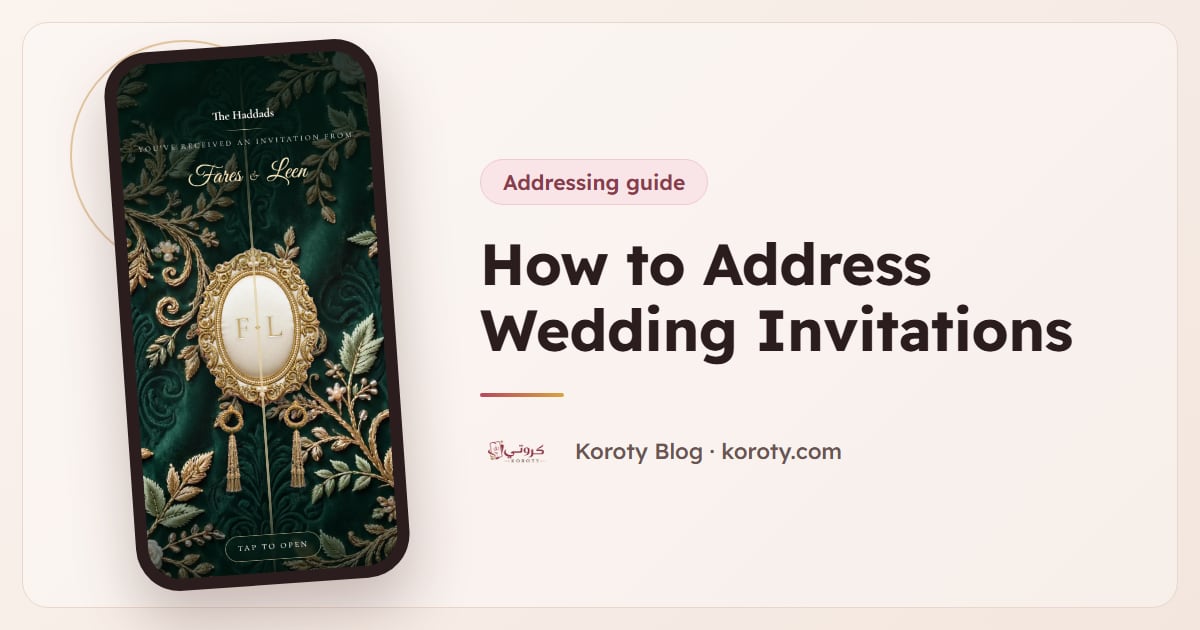
On a digital invitation, the name you enter is the name the guest sees. On Koroty, each guest you add gets a personal link, and the name you type appears on that guest's envelope. So write it the way you would like them to be greeted when they tap it.
- "The Johnson Family" for a family you want to welcome together.
- "Aunt Rosa" or "Uncle Sam" for relatives.
- "Dr. Priya Shah" for a doctor who uses the title.
- "Hana and Adam" for a couple.
- "Ms. Priya Shah and Guest" if a plus-one is allowed.
The name should also match the seat limit you set: if "The Johnson Family" has a limit of four, then the family of four is invited. For how limits work, read plus-one wedding invitation wording. You can add guests one by one, paste a list of names or import Excel or CSV, and fix any name later in the guest list. Designing is free, and the permanent link is one payment per invitation; see the pricing page.
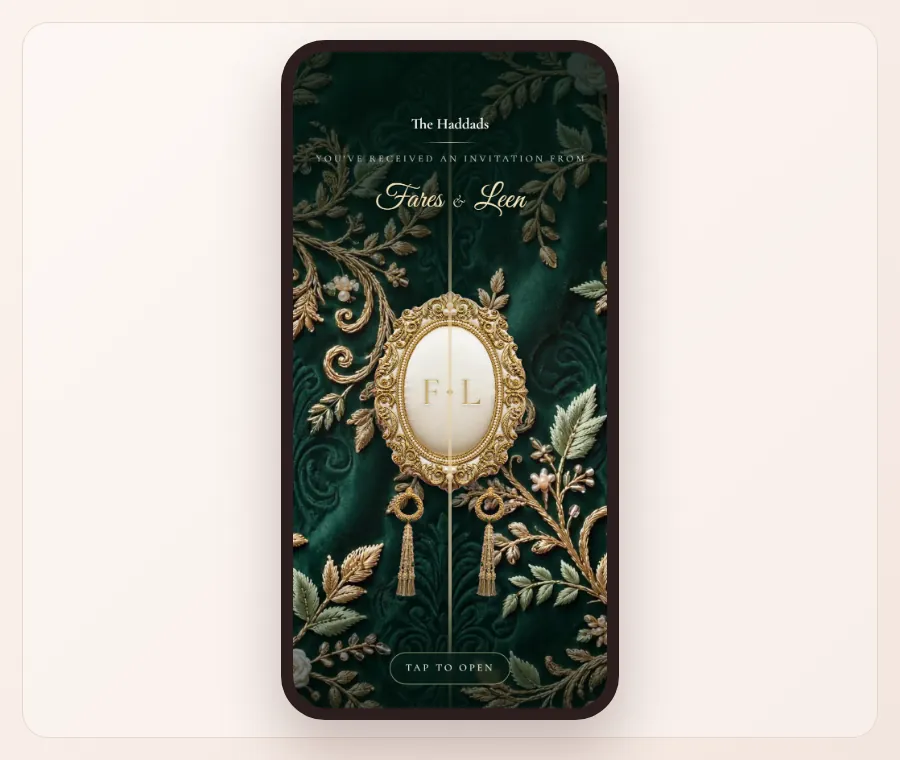
Notice where the name sits: on Emerald Palace, it greets the guest before the emerald velvet doors open onto a domed palace. Design yours free and see a guest's name on the envelope.
For sending the links, read send wedding invitation on WhatsApp.
Which digital name forms work best? #
| Guest | What to type | What the guest sees on the envelope |
|---|---|---|
| A family of four | The Johnson Family | A warm family greeting |
| A favorite aunt | Aunt Rosa | Her name as you call her |
| A couple | Hana and Adam | Both names, equal weight |
| A guest with a title | Dr. Priya Shah | Her title and name |
| A guest and a plus-one | Ms. Priya Shah and Guest | The seats you offer |
| An older relative | Mr. and Mrs. Ali | A formal tone |
If you paste a list, check the spelling once before you send. A wrong name is easier to fix before the link goes out.
What mistakes should you avoid? #
- Leaving out names you meant to include. If a child, partner or relative is invited, name them.
- Assuming a woman's title. Ask or use "Ms."
- Using a nickname on a formal card unless the guest would like it.
- Misspelling names. Check spellings against messages or contact lists.
- Forgetting titles that matter, like Dr., Sheikh or Reverend.
- Using "and family" without stating who the family is, if numbers are limited.
What are some address samples for different cases? #
Mr. and Mrs. Daniel Reyes
Dr. Priya Shah and Mr. Dev Patel
Ms. Maria Lopez and Mr. Daniel Reyes
The Haddad Family
Ms. Hana Aziz and Guest
Mr. Adam Collins and Mr. Ben Carter
Aunt Rosa and Uncle Carlos
Imam Yusuf Ali and Mrs. Ali
Frequently asked questions #
Should I use "Mrs." or "Ms."? #
Use "Mrs." for a married woman who uses it. When you aren't sure, "Ms." is a safe choice.
How do I address a couple with different last names? #
Put both full names on one line, each with their own title, joined by "and."
Is "The Smith Family" polite? #
Yes, for casual and digital invitations. For formal paper ones, name each person invited.
Do I use first names on a digital invitation? #
Often yes. Use the form your guest would like, like "Aunt Rosa" or "Hana and Adam."
Should children be on the envelope? #
Name them if they are invited. If they are not, address the invitation only to the parents.
The bottom line #
Address each guest the way they would like to be addressed, name everyone who is invited, and ask when you aren't sure. Design yours free, or read the digital wedding invitations guide.