
The clearest way to say who is invited is to address the invitation to exactly the people you mean: "Ms. Amina Khalil and Mr. Tariq Nasser" for a couple, "Ms. Amina Khalil and Guest" for a plus-one, and "Ms. Amina Khalil" alone for one seat. Then add a gentle line if you need to, such as "We are unable to accommodate additional guests." Below are the rules of thumb and 20 samples.
The plus-one question causes more worry than almost any other part of a guest list, because it touches budget, space and feelings. The best approach is a simple rule you can explain, applied the same way to everyone. For the list itself, read how to build a wedding guest list.
Who should get a plus-one? #
There is no universal rule, but a common pattern looks like this:
- Married, engaged and live-in partners: invited as a couple, by name.
- Long-term partners: usually invited by name, even if unmarried.
- Wedding party members: often given a guest, since they spend long days with you.
- Guests who know almost nobody: sometimes offered a guest as a kindness.
- Casual dates: often not included, if space or budget is tight.
Pick the rule that fits your budget and venue, and apply it evenly. People can accept a "no" when it clearly isn't personal.
How can you decide quickly who gets a plus-one? #
If the list is stuck, answer three questions for each guest. Do they have a serious partner? Will they know other people at the wedding? Does your headcount have room? This table turns the answers into a decision.
| Situation | Suggested choice | Why |
|---|---|---|
| Spouse, engaged or live-in partner | Invite the partner by name | Leaving them out is hurtful |
| Long-term partner you have not met | Invite by name; ask the guest for it | Same reasoning, and it feels warm |
| Wedding party member, single | Offer a guest | Their day is long and you are asking a lot |
| Single guest who knows many people | Invitation for one | They will be among friends |
| Single guest who knows few people | Consider a guest | It is a kindness, if space allows |
| New casual date | Usually not | Space and budget |
Write your rule down before you start sending, so you answer the same way each time.
How do you word "and guest" on an invitation? #
The wording on the envelope or the name line is the most direct signal. If you know the partner's name, use it. If you don't, "and Guest" is the usual formula.
Ms. Amina Khalil and Guest
Mr. Daniel Reyes and Guest
Dr. Priya Shah and Mr. Dev Patel
Always try to learn the partner's name. "And Guest" feels more welcoming when you also say a line like the one below.
We would love to meet your partner. Please let us know their name when you reply.
How do you say a guest is invited alone? #
Address the invitation to the person only. Add a polite line if you expect questions.
Due to limited space, we are unable to offer additional guests. We thank you for understanding.
We are keeping our celebration small, and the seat on this invitation is reserved for you. We hope to see you there.
Your invitation is for one. We can't wait to celebrate with you.
How do you word an invitation for a couple or family? #
Name everyone, so no one guesses.
The Ruiz family: Camila, Andres, Sofia and Mateo
Mr. and Mrs. Samir Haddad
Ms. Hana Aziz and Mr. Adam Collins
For how to write names correctly, see how to address wedding invitations.
How do you word an adults-only or no-kids invitation? #
Say it kindly, early, and in the same place for everyone. Don't rely on guests reading between the lines.
We love your little ones, but our celebration will be adults only. We hope you can enjoy a night out.
Out of respect for our venue, we kindly ask that only the guests named on the invitation attend.
Please note that children under 14 are welcome only when named. Thank you for understanding.
For longer samples and etiquette, see no kids wedding invitation wording.
What if a guest asks to bring someone you didn't invite? #
Stay warm, but hold to your rule. A short reply works well.
Thank you so much for asking. We're keeping to the guests named on the invitation because of venue space. We'll miss having your friend there, and we hope you understand.
We wish we could, but our guest list is full. We'd love for you to come regardless.
If a guest says they won't come without a plus-one, accept it gracefully. Don't try to negotiate it into a favor you will regret.
How do you write the RSVP line so guests know their number? #
Be specific about the seats on the reply, so guests don't have to guess.
We have reserved two seats in your honor. Please let us know if both of you will attend.
We have reserved one seat for you. We hope you can join us.
Please reply for yourself and your guest by May 15, 2027.
The names on your invitation tell you who is invited. Please reply for everyone listed.
What should you do about last-minute additions? #
Decide in advance whether you can be flexible. If you can, tell your guests that they may ask and that you will confirm. If you can't, say so up front. Keep a small list of "maybe" guests you can invite if others decline, and follow your RSVP deadline. See wedding RSVP guest count for how to manage the final number.
If your plans change, please let us know as soon as possible so we can adjust the seating.
How does a plus-one limit work on Koroty? #
On Koroty you set a seat limit for each guest, and the guest chooses how many people are coming, up to that limit. If a guest's limit is one, they cannot add another person on the RSVP. If it is two, they can bring one more. So the limit on the page matches the invitation you meant to send. It's a quiet way to avoid awkward conversations, since the form simply doesn't offer more seats. You can also add a custom question, such as "Plus-one name," so you learn who is coming. Designing is free, and the permanent link is one payment per invitation; see the pricing page.
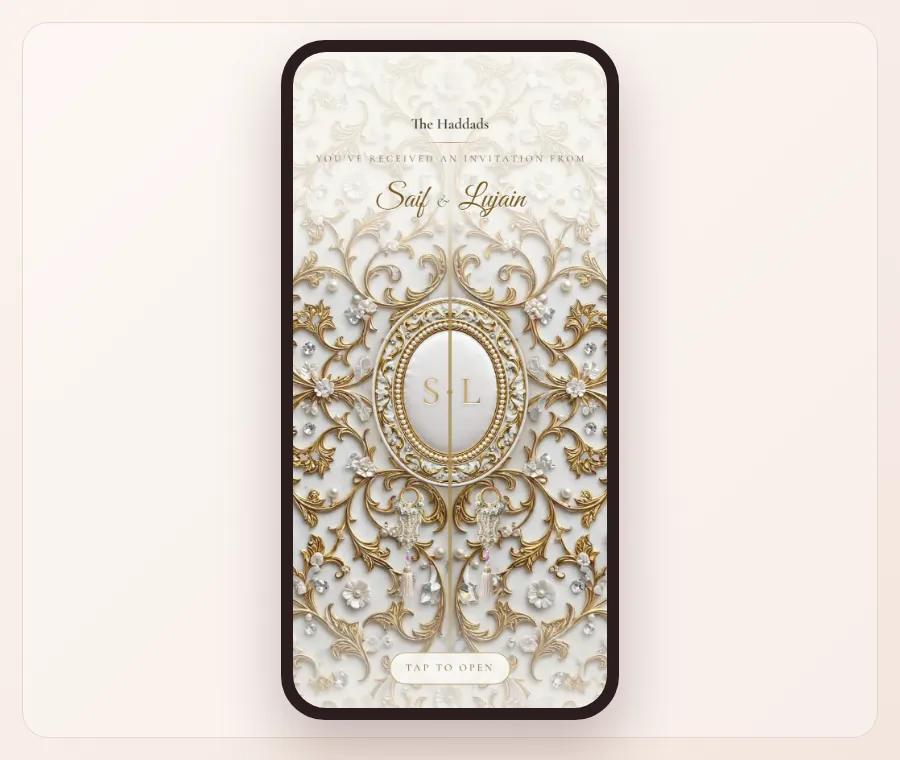
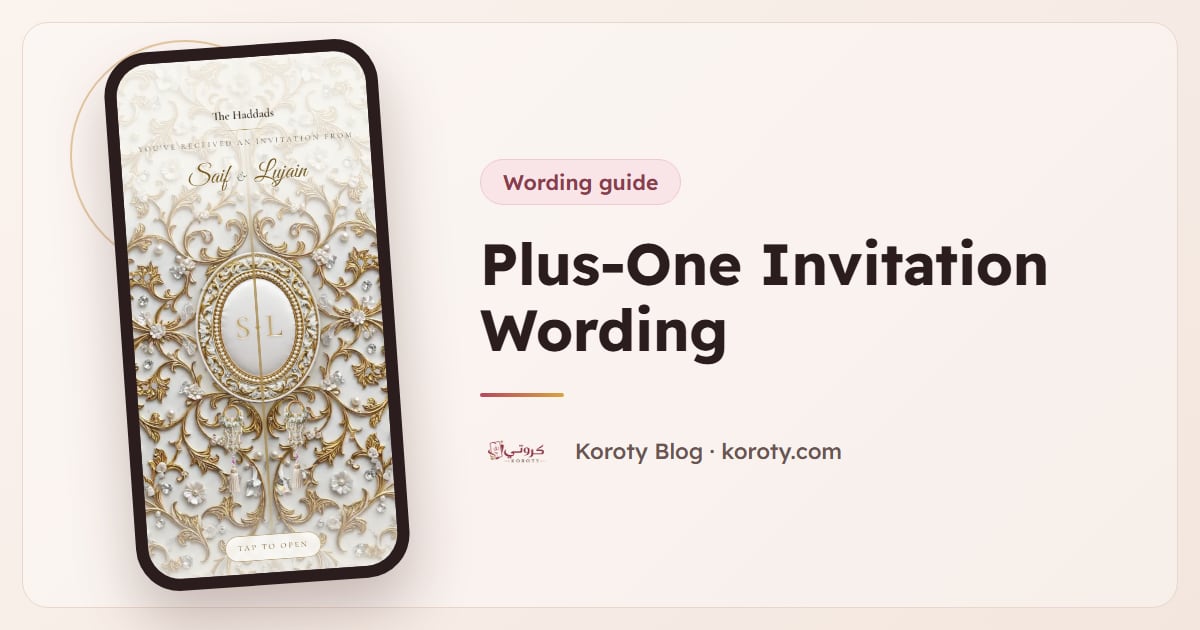
The envelope above, on Pearl Palace, names the guest exactly as you entered them, which is where a plus-one becomes clear. Design yours free and set the seat limit for each guest.
How do you apply the rule to a guest list? #
Here is how an invented couple, Hana and Marc, settle plus-ones for six guests. The names are made up; the reasoning follows the table above.
| Guest | Situation | Name on the invitation | Seats |
|---|---|---|---|
| Omar Saleh | Married | Mr. and Mrs. Omar Saleh | 2 |
| Julia Brandt | Engaged | Julia Brandt and Felix Wagner | 2 |
| Dana Haddad | Single, knows many guests | Dana Haddad | 1 |
| Chris Lee | Single, flying in, knows almost no one | Chris Lee and Guest | 2 |
| The Nassar family | Two parents and two children | The Nassar Family | 4 |
| Sami Aziz | Colleague, single | Sami Aziz | 1 |
Their rule in one line: settled partners are named, a guest who would be alone among strangers gets a guest, and everyone else is invited by name only. The seat number is what each guest can reply for. On Koroty, that is the seat limit you set for each guest, so a reply for more people than the number is not possible.
Frequently asked questions #
Do I have to give every guest a plus-one? #
No. Etiquette doesn't require it. Choose a rule that fits your space and budget, and apply it fairly.
Is it rude to say "no plus-ones"? #
Not if you say it kindly and apply it evenly. A short note about space is usually enough.
Should I invite my guests' partners if I've never met them? #
Inviting long-term partners is considered thoughtful, even if you haven't met. Ask your guest for the partner's name.
How do I word it if only some guests get a plus-one? #
Address each invitation to exactly who is invited. You don't need to explain the difference.
Can the RSVP prevent extra guests? #
Yes, if your invitation has a limit per guest. On Koroty, guests can't pick more people than their limit.
The bottom line #
Address each invitation to exactly the people you mean, add one kind line if needed, and use the same rule for everyone. Design yours free, or read the digital wedding invitations guide.